
Big Bass Bonanza 2 Mechanics
Hi, I’m David G. Schwartz.
I’ve spent years studying how gambling systems are designed — not just from a player’s perspective, but from a structural and mathematical standpoint. When I analyze a slot, I’m not asking whether it’s “fun.” I’m asking where the volatility sits, how the RTP is distributed, and what kind of behavior the machine is engineered to produce.
Today, we’re breaking down one of the most recognizable modern bonus-driven slots on the market:
Big Bass Bonanza
Developed by Pragmatic Play, this game looks simple on the surface. Five reels. Fishing theme. Cartoon fisherman. Nothing intimidating.
But structurally? It’s a volatility engine built around one explosive feature.
Let’s unpack it properly.
Game Structure & Core Specifications
Before we talk about strategy or winning potential, we need to understand the framework.
Configuration:
- 5 reels
- 3 rows
- 10 fixed paylines
- High volatility
- RTP: typically 96.71% (operator version may vary)
- Maximum win: 2,100x stake
At first glance, this looks like a traditional, almost old-school setup. No Megaways. No tumbling reels. No cluster mechanics.
And that’s intentional.
By keeping the base game simple, the developer can concentrate the mathematical weight into one specific area: the Free Spins feature.
This slot is not designed to reward steady grinding.
It is designed to deliver burst payouts.
Why the Base Game Feels “Cold”
Let me be direct.
If you play 100 spins and feel like nothing meaningful happened — that’s by design.
Here’s what’s happening structurally:
- Hit frequency is moderate
- Most wins are small relative to your stake
- Large base-game hits are extremely rare
- Money fish appear but do not pay on their own
That last point is critical.
Money symbols display values during regular spins, which creates anticipation. But those values only pay when collected by the Fisherman during Free Spins.
Psychologically, this builds tension.
Mathematically, it suppresses base-game volatility.
Where the RTP Actually Lives
Most players see “96.71% RTP” and assume every spin contributes evenly.
That’s not how high-volatility slots work.
In Big Bass Bonanza, a significant portion of the theoretical return sits inside the bonus feature.
Approximate RTP Distribution Model
- Base Game: ~35–45%
- Free Spins: ~55–65%
That means more than half of the slot’s value is locked behind one event: triggering Free Spins.
If you never reach the bonus during your session, your realized RTP will be far lower than the advertised number.
That’s not bad luck.
That’s variance.
Scatter Logic & Trigger Frequency
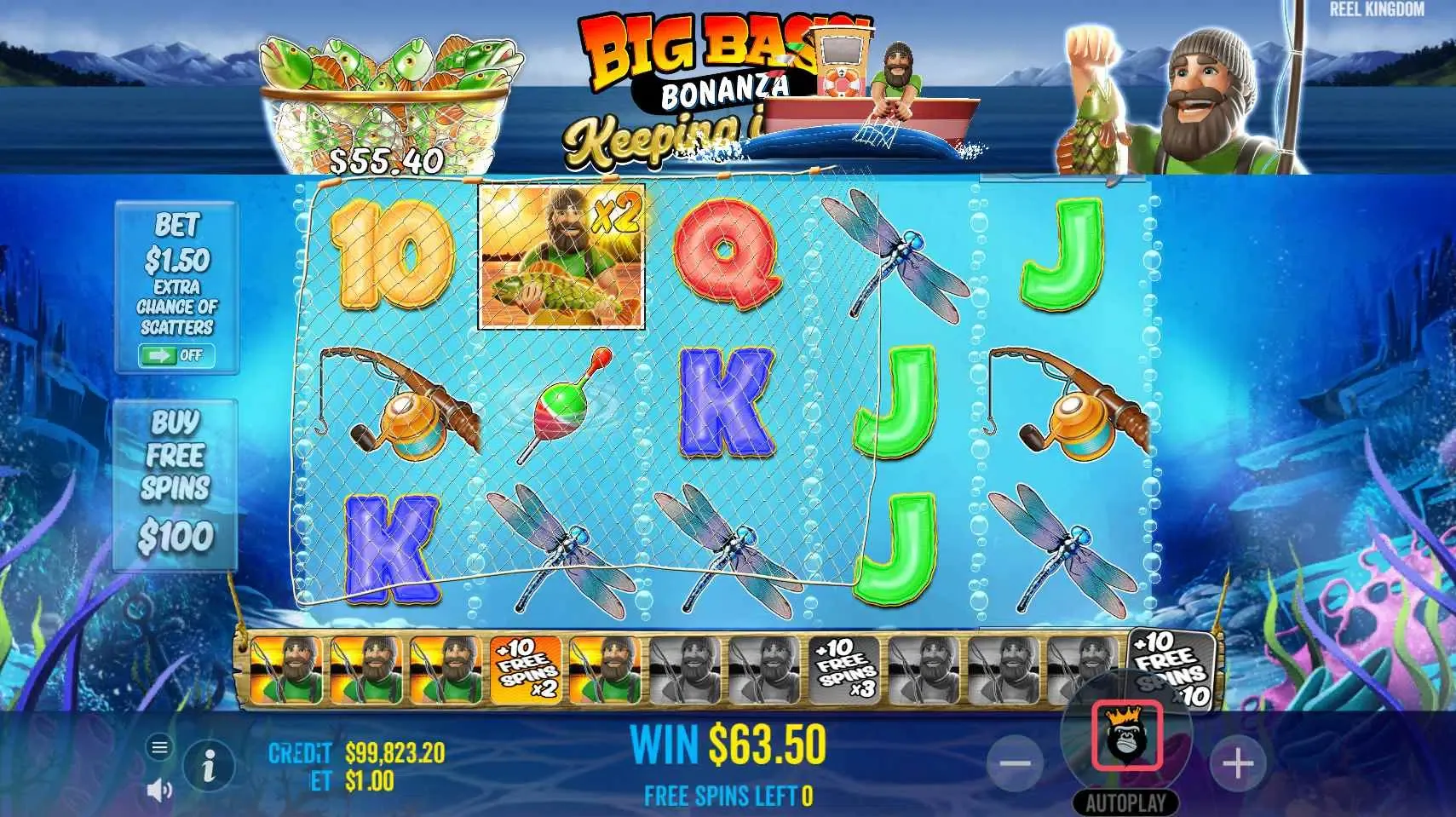
Free Spins are triggered by landing 3 Scatter symbols anywhere on the reels.
- 3 Scatters → 10 Free Spins
- Retriggers possible
Based on long-session tracking and volatility modeling, the trigger frequency typically falls around:
1 in 90–120 spins
That range is wide enough to create very different session experiences.
You might hit it quickly.
You might wait 150 spins.
Both outcomes are statistically normal.
Session Expectation: What Most Players Experience
Let’s model a realistic example:
- Bankroll: $100
- Bet size: $0.50
- Around 200 spins available
Three typical outcomes:
- ❌ No bonus trigger → gradual bankroll decline
- ⚖️ One average bonus → near break-even session
- 🚀 Strong bonus with collector progression → session-defining win
Because most of the RTP sits inside Free Spins, the game behaves in spikes, not steady climbs.
Big Bass Bonanza doesn’t reward patience with small consistent gains.
It rewards players who survive long enough to reach the volatility peak.
The Real Engine of Big Bass Bonanza: Fisherman Collector System
If you remember only one thing about Big Bass Bonanza, remember this:
The base game is just a waiting room.
The bonus is the real game.
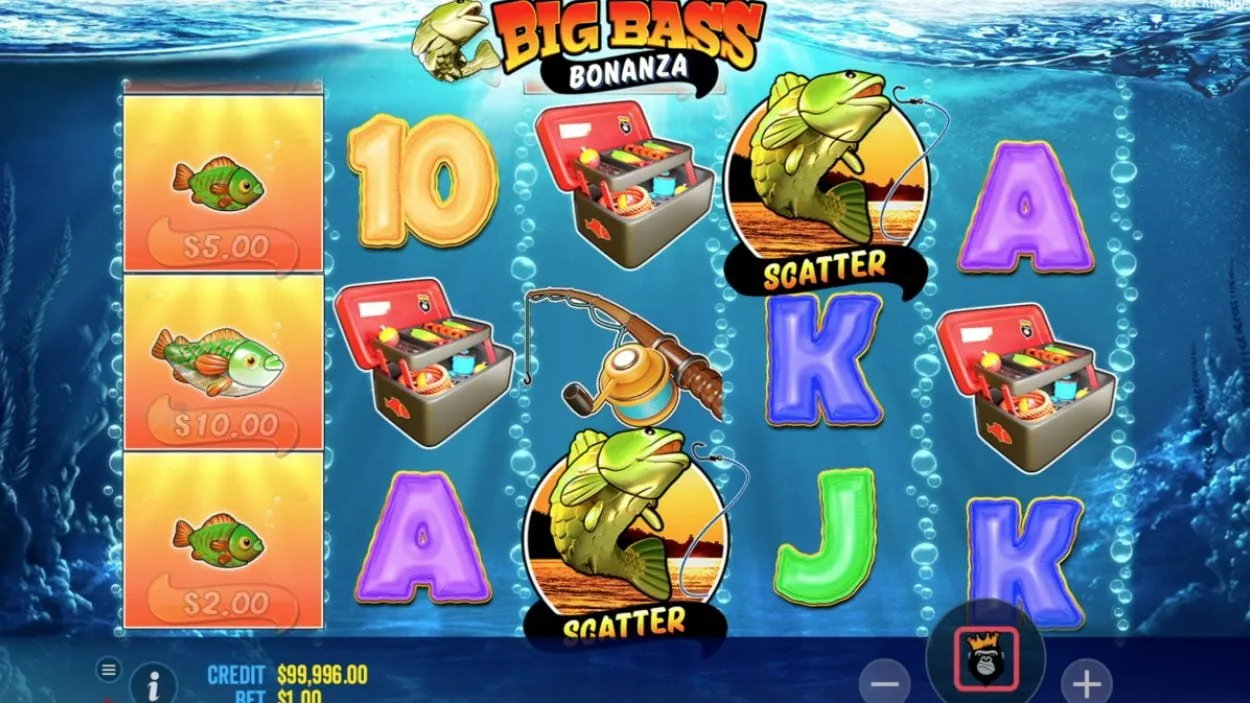
During Free Spins, the Fisherman symbol transforms from a regular premium icon into a collector wild.
Here’s how it works:
- Money Fish symbols appear with random values (e.g., 2x, 5x, 10x, 50x stake).
- If at least one Fisherman lands on the screen during that spin,
- He collects ALL visible Money Fish values.
- The total is paid instantly.
This mechanic creates asymmetric payout potential.
You’re not winning because of paylines anymore.
You’re winning because of value aggregation.
Fisherman Collector Logic
- 🎣 Money Fish land with cash values
- 🧍 Fisherman Wild appears
- 💰 All Money Fish values are collected
- 📈 Total value paid instantly
No Fisherman = No Collection
That final line is crucial.
Without the Fisherman, money symbols are completely worthless.
That’s the tension mechanic.
Bonus Volatility Structure
Now let’s talk about what makes this slot dangerous — in a mathematical sense.
The Free Spins feature doesn’t just give you 10 spins. It includes a progression ladder.
For every 4 Fisherman symbols collected during the bonus round, you unlock:
- +10 additional Free Spins
- +1 additional Fisherman added to the reels
This creates exponential payout growth.
🎣 Bonus Tier Progression Visualization
Free Spins Progression Ladder
| Fishermen Collected | Active Fishermen | Extra Spins |
|---|---|---|
| 0–3 | 1 | — |
| 4–7 | 2 | +10 |
| 8–11 | 3 | +10 |
| 12+ | 4 | +10 |
Now let’s interpret this.
At Tier 1, you have only one collector.
At Tier 4, you can have up to four collectors landing simultaneously.
If multiple Fishermen land in one spin, they multiply the total collected value.
This is where session-defining wins happen.
Expected Bonus Value Curve
Let’s simplify the math conceptually:
- Early bonus stage → small collection spikes (5x–20x stake)
- Mid progression → 40x–100x potential swings
- Final tier → 200x+ possibilities in a single spin
This slot compresses volatility into a narrow window of opportunity.
Bonus Value Growth Curve
Tier 1 → Tier 2 → Tier 3 → Tier 4
The takeaway:
Most bonuses end early.
A few climb the ladder.
Very few reach full expansion.
That’s textbook high volatility behavior.
Psychological Volatility vs Mathematical Volatility
Here’s something important for serious players:
This slot feels streaky because the reward distribution is top-heavy.
You can experience:
- 150+ spins without meaningful gain
- Then one bonus that pays 300x stake
The math allows that. It’s not “due.” It’s just distribution.
Practical Advice From a Structural Perspective
If you want to test Big Bass Bonanza properly:
- Use controlled bet sizing
- Expect long dry spells
- Don’t increase stake chasing a missed bonus
- Understand that survival is part of the strategy
You cannot influence symbol outcomes.
What you can control is exposure.
Can You Actually Win at Big Bass Bonanza?
Let’s address the question directly.
Yes — you can win.
No — you cannot control when.
That distinction matters.
🎣 Big Bass Bonanza
Big Bass Bonanza is governed by RNG (Random Number Generator). Every spin is independent. There is no memory, no pattern, no “hot cycle.”
What determines your outcome is variance distribution.
Because more than half of the RTP sits inside the Free Spins feature, your session result depends heavily on:
- Whether you trigger the bonus
- How far you climb the collector ladder
- Whether multiple Fishermen land on high-value fish
This is probability compression, not strategy.
🎯 Understanding Winning Probability in Context
Let’s simplify expectations.
Out of 100 players spinning 200 times each:
- A portion will never reach Free Spins
- Many will trigger once and receive a modest payout
- A small percentage will hit multi-tier progression
- A very small percentage will capture a high-multiplier spike
That uneven distribution creates stories.
But mathematically, it’s normal variance.
📊 Bankroll Survival Framework
Bankroll Exposure Model
| Bankroll | Bet Size | Estimated Spins | Risk Level |
|---|---|---|---|
| $100 | $0.50 | ~200 | Moderate |
| $100 | $1.00 | ~100 | High |
| $100 | $2.00 | ~50 | Extreme |
Key takeaway:
High volatility slots require time to express their mathematical potential.
If your bankroll doesn’t allow enough spins to reasonably reach the bonus window (90–120 spins average), you are increasing variance against yourself.
Stop-Loss & Exit Logic
Here’s how I approach bonus-heavy slots structurally:
✔ Set a fixed loss limit before starting
✔ Avoid doubling stakes after dry runs
✔ Consider leaving after a major 200x+ hit
✔ Treat each session as independent
Many players give back large wins because they assume continuation momentum.
That’s a cognitive trap.
Slots do not have memory.
📈 Volatility Spike Model
Typical High-Volatility Session Curve
Long decline → Sudden spike → Stabilization
This is what Big Bass Bonanza is built to do.
Not steady growth.
Compressed payout explosion.
Comparison: Why This Slot Feels Different
Compared to medium-volatility classics like:
⭐ Starburst
Starburst distributes RTP more evenly across spins. You feel frequent activity.
Big Bass Bonanza concentrates return inside a small number of events.
It’s the difference between:
- Steady drizzle
- Thunderstorm payout
Both are mathematically valid.
They simply feel different.
Who Should Play Big Bass Bonanza?
This slot fits players who:
- Enjoy bonus anticipation
- Accept long dry spells
- Prefer spike potential over steady grinding
- Manage bankroll consciously
It does NOT suit players who:
- Expect consistent small returns
- Chase losses
- Increase stakes emotionally
Understanding this distinction prevents frustration.
Big Bass Bonanza is a volatility-driven collector slot engineered for tension and release.
The base game builds pressure.
The bonus releases it.
When you approach it with structural awareness — not emotional expectation — you play smarter.
Remember:
You cannot change the math.
But you can change how you expose yourself to it.
Play responsibly. Set limits. Treat it as entertainment — not income.
That’s the only sustainable strategy.